Engineering change management
Engineering changes, done.
Onleap recovers why every part is the way it is, from your PLM, CAD and mail, so a change starts from what is already known, not from a search.
Change CR-001 · Now
Replace DLC coating with uncoated PEEK on cold-fill water lines
In progress- Researchdone
- Judgeverdict ready
- Implementnext
- Donenext
The problem
Most of a change is searching.
A part changes to fix a safety issue, cut cost or correct a design error. The new design is rarely the slow part. Finding out why the old one is the way it is, is.
- Requestprioritised
- Searchwhere it stalls
- Find initial specsnext
- Re-specnext
- Alignmeetings, mail
- Re-engineernext
- Releasenext
How it works
One view of what changed, and why.
Onleap works on top of the systems you already run. It finds the history, fills the gaps and keeps the paperwork moving.
- 1
Connect your systems
Link PDM, PLM, CAD and ERP. Your data stays where it is.
- 2
Fill the gaps
Pull in the files and mail from everyone involved, so the missing context is there.
- 3
Reconstruct the history
See what changed, why, by whom, and what it affects. One view per part.
- 4
Automate the paperwork
Reports and next steps run themselves. Less bureaucracy, more engineering.
The product
The history behind a part, on one screen.
Screens from the platform, built on your existing data and shown here with example data.
01 / 04
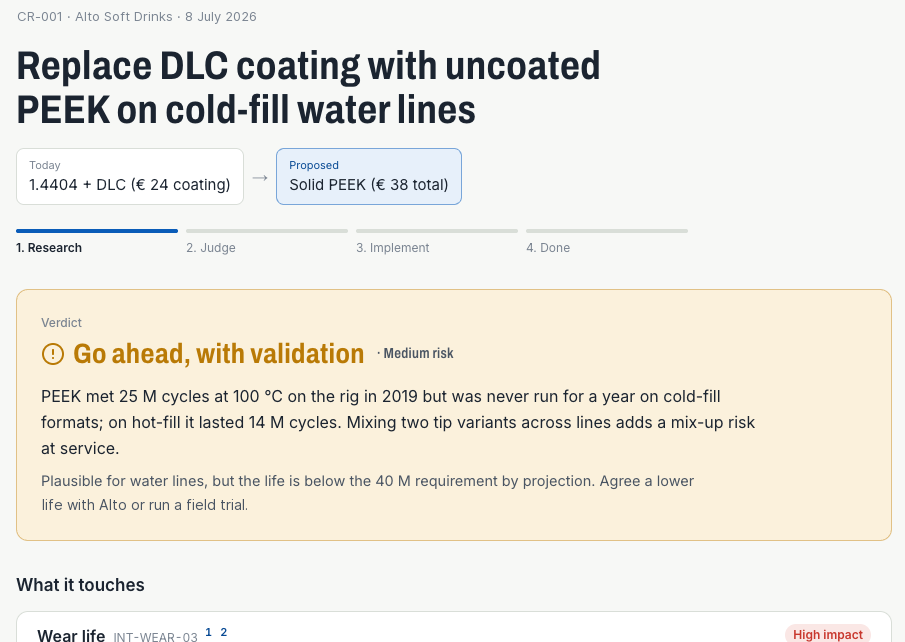
Judge a change against its history
Every change gets a verdict with the evidence behind it: what was tested, what failed and what it touches.
02 / 04
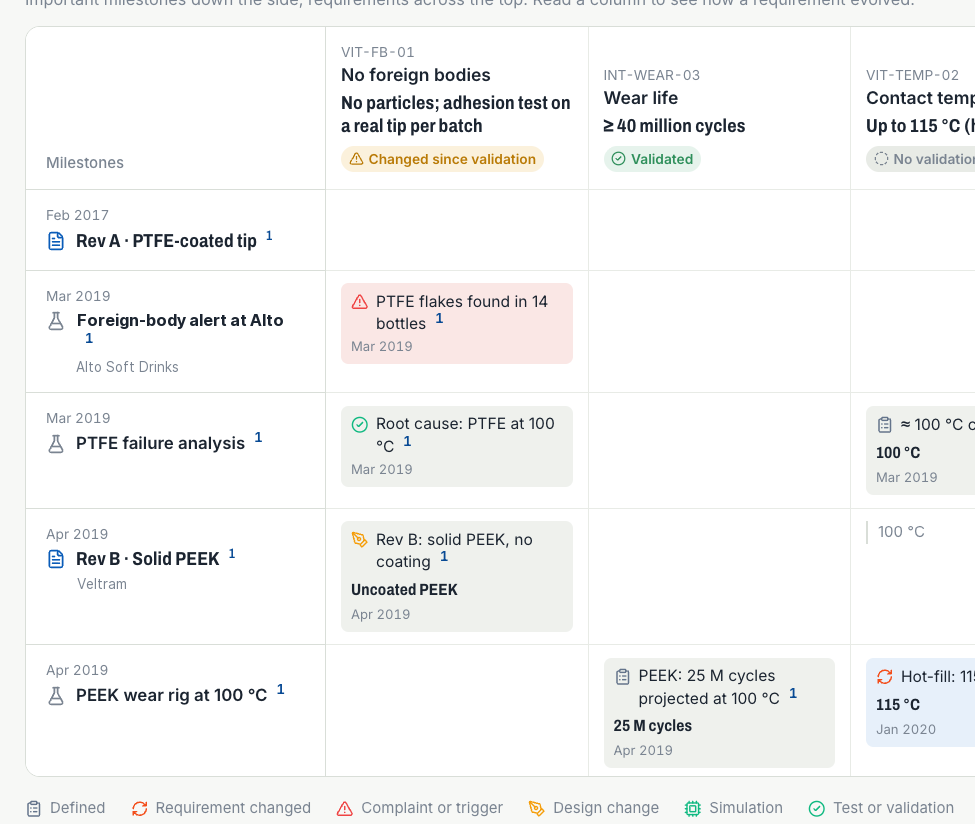
Recover how a requirement evolved
Milestones down the side, requirements across the top. Read a column to see what changed a requirement, and what it triggered.
03 / 04
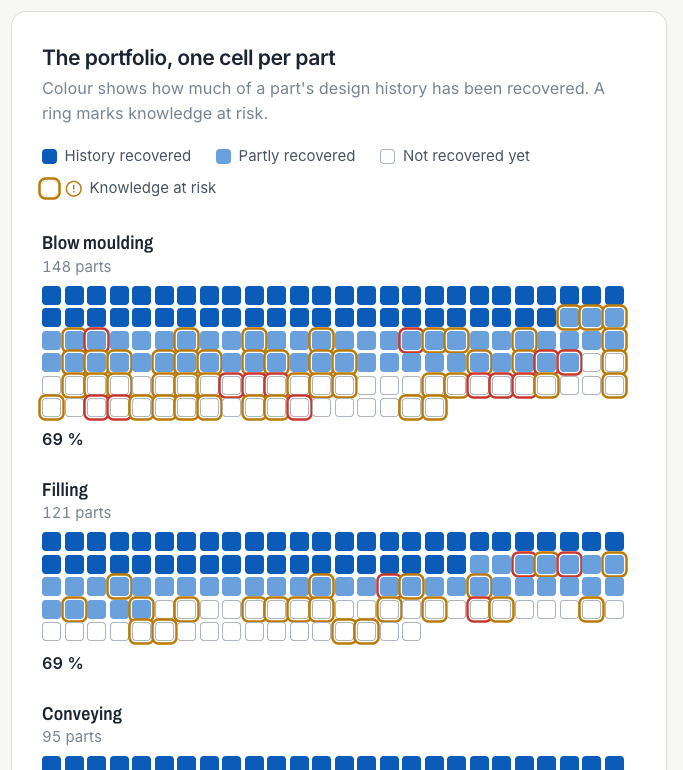
Find where knowledge is at risk
One cell per part. Colour shows how much of its design history is recovered. A ring marks knowledge at risk.
04 / 04
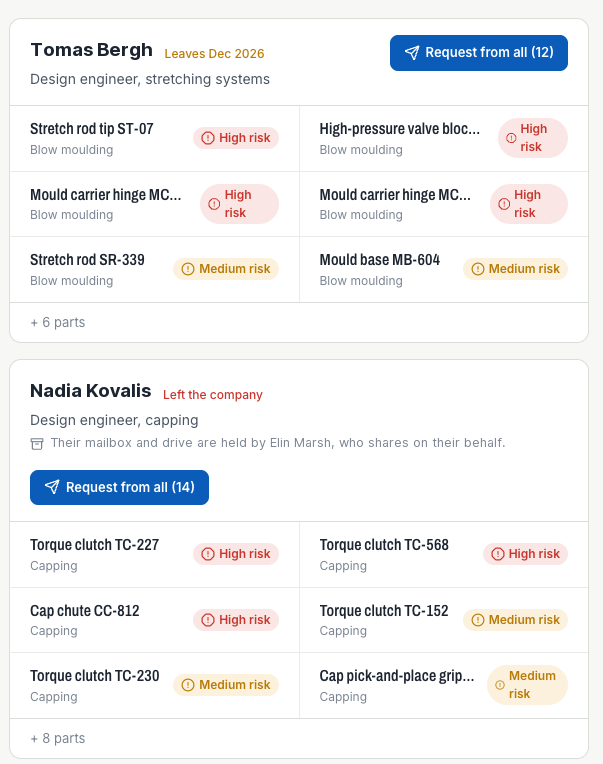
Ask before someone leaves
See the parts tied to an engineer who is leaving, ranked by risk. Request what they know in one step.
Who it is for
Built for machine builders.
If your engineers spend more time searching than engineering, Onleap is built for you.
Sound familiar?
Change requests
A customer asks for a change, and nobody can say why the part is the way it is.
Knowledge
The engineer who knows the design is about to retire, or has already left.
Systems
You run Teamcenter, SAP or a legacy PLM, and you are not going to replace it.
Capacity
Capacity is tight, and too much time goes on searching instead of engineering.
Is this you?
- Company
- Machine builders that sell what they design
- Size
- 100 to 1,000 people
- Sectors
- Packaging, high tech
- Systems
- Teamcenter, SAP, or a legacy PLM or PDM you will keep
Uses it every day
- Design engineers
- Product managers
Works from the same history
- Project managers
- Process and manufacturing engineers
- Quality and compliance engineers
- Supply chain managers
- Procurement and sourcing specialists
Signs it off
- Engineering director
- VP service engineering
Finance asks what it saves. IT asks where the data lives: in your private cloud in the EU, or on-premise.